FORE:On the 1st of March Mr. Villiers, adhering to his principle, brought forward the last of those annual motions for immediate repeal which had contributed so powerfully to undermine the Corn Laws. After a spirited debate of two evenings, in the course of which Mr. Cobden warned the monopolist party that a protracted resistance would compel the Anti-Corn-Law League to maintain its agitation and concentrate its energies, the House rejected the motion by a majority of 267 to 78.
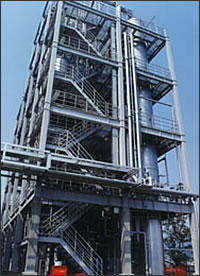
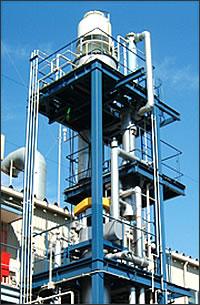
Methanol refinement systems, amyl alcohol refinement systems, ethanol refinement systems, hexanol distillation systems, propanol refinement systems, cyclohexanol distillation systems, isopropanol dehydration systems, ethylene glycol recovery systems, and butanol distillation systems.
FORE:[See larger version]
Hexane distillation systems, tall oil distillation systems, benzene distillation systems, lubricating oil refinement systems, xylene-free distillation systems, low-boiling gas distillation systems, ethylbenzene recovery systems, fusel oil distillation systems, naphthalene distillation systems, propylene recovery systems, and turpentine oil distillation systems.
FORE:Meanwhile by the advice of Bute the king sent for Pitt. On the 27th of August he had an audience of the king at Buckingham House. Pitt, however, insisted on having in with him all, or nearly all, his old colleagues, and this was too much for the king; whilst not to have had them would have been too little for Pitt, who was too wise to take office without efficient and congenial colleagues. The king, nevertheless, did not openly object, but allowed Pitt to go away with the impression that he would assent to his demands. This was Saturday, and Pitt announced this belief to the Dukes of Devonshire and Newcastle, and the Marquis of Rockingham. But on Sunday Grenville had had an interview with the king, and finding that he considered Pitt's terms too hard, had laboured successfully to confirm him in that opinion. Accordingly, on Monday, at a second meeting, the king named the Earl of Northumberland, Lord Halifax, and George Grenville, for leading posts in the Cabinet, saying, "Poor George Grenville, he is your near relation, and you once loved him." Pitt said that it would not do, bowed and retired; the king saying, "My honour is concerned, and I must support it."Amongst the followers of Whitefield became[170] conspicuous Rowland Hill, Matthew Wilks, and William Huntington. Of the followers of Whitefield, Selina, Countess of Huntingdon, became the patron, as she had been of Whitefield himself, whom she made her chaplain. This remarkable woman founded schools and colleges for the preachers; and so completely did she identify herself with this sect that it became styled "Lady Huntingdon's Society." Perhaps the most celebrated of these preachers, after Whitefield, was Rowland Hill, who was a younger son of Sir Rowland Hill, of Hawkstone, in Shropshire. He was educated at Cambridge for the Church of England, but preferred following Whitefield, and for many years went about preaching in the open air, like Whitefield, in different parts of the country, and particularly amongst the colliers of Kingswood. In 1783 his chapel, called the Surrey Chapel, being built, he settled in London, and continued his ministry in the metropolis till his death in 1833, at the age of eighty-eight. Rowland Hill was as much celebrated for his humour and eccentricity, which he carried into his preachings, as for his talents. He was also an author of various productions, the most popular of which were his "Village Dialogues."
Ether distillation systems, camphor distillation systems, epichlorohydrin distillation systems, aniline distillation systems, dioxane refinement systems, acetonitrile distillation systems, furfural refinement systems, formalin distillation systems, cyclohexane distillation systems, monoethanolamine rectification systems, polyglycol ether distillation systems, dimethylformamide recovery systems, acrylic glycol ether distillation systems, acrylonitrile refinement systems, acetone recovery systems, pyridine distillation systems, methyl ethyl ketone recovery systems, picoline distillation systems, methyl isobutyl ketone recovery systems, and acetaldehyde recovery systems.